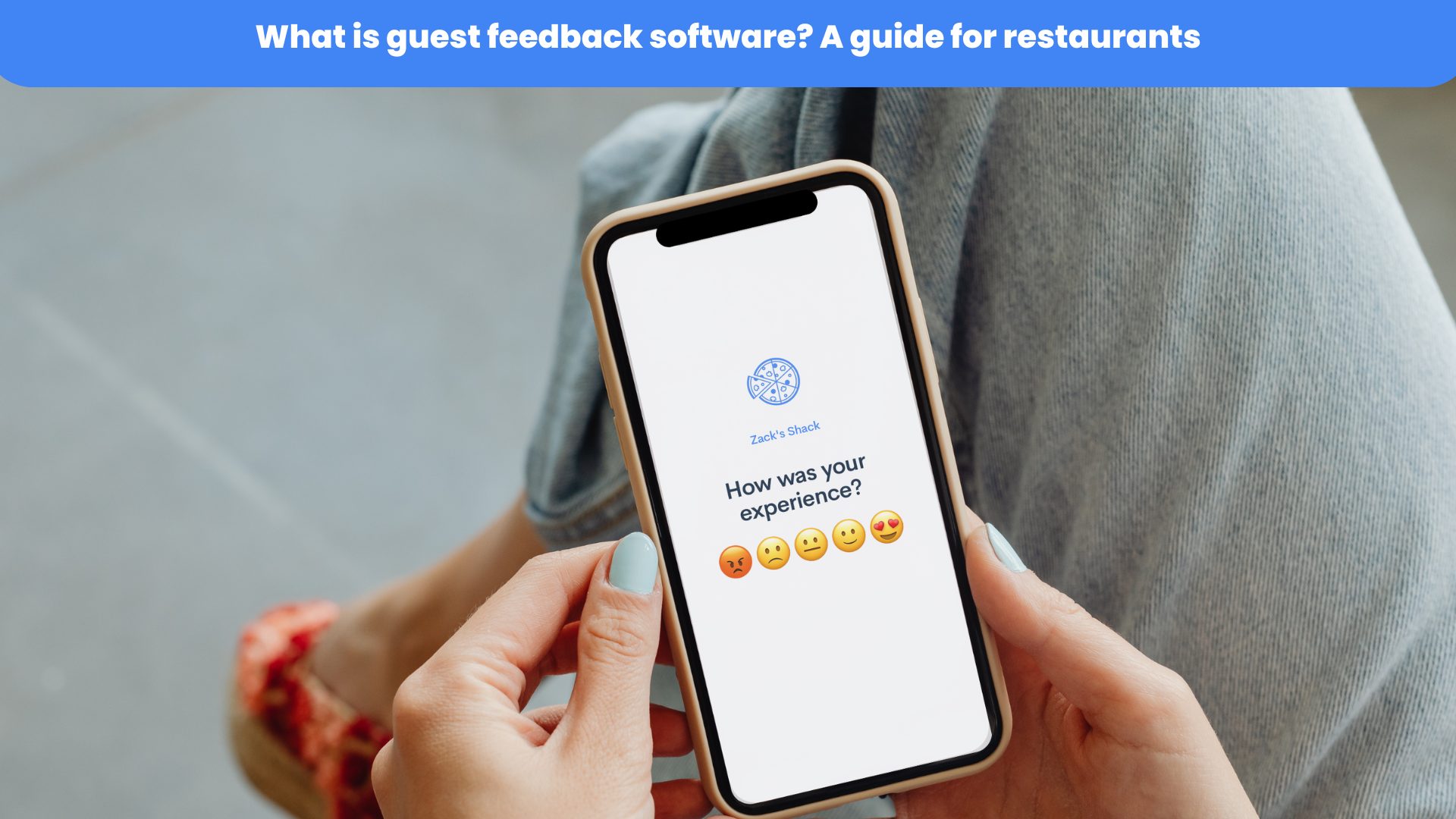
If you’ve ever watched a guest leave your restaurant and wondered what they actually thought — you already understand the problem guest feedback software is designed to solve.
Most restaurant operators learn about guest dissatisfaction one of two ways: a manager happens to notice something is wrong, or a one-star review shows up on Google the next morning. By then, it’s too late. The guest is gone, the experience is over, and the damage to your reputation is already done.
Guest feedback software changes that equation entirely.
What is guest feedback software?
Guest feedback software is a platform that helps restaurants collect, organize, and act on feedback from guests — ideally while the experience is still happening, or immediately after.
At its most basic, it gives guests a simple way to share how their visit went: a short survey delivered by QR code, a text message, or a receipt link. The restaurant receives that response in real time, and managers can respond, recover, or flag the issue before the guest walks out the door.
More advanced platforms go further — routing negative feedback directly to on-duty managers, identifying patterns across locations, and integrating with your existing systems to surface operational trends over time.
Why can’t restaurants just rely on Google or other reviews?
Public review platforms like Google and TripAdvisor are important for visibility — but they’re a poor feedback mechanism for a few key reasons:
You find out too late. By the time a guest posts a review, they’ve already gone home, cooled down, and made up their mind. There’s no opportunity to recover the experience.
Most unhappy guests don’t leave reviews — they just don’t come back. Research consistently shows that the majority of dissatisfied customers say nothing publicly. They simply don’t return. You lose a guest and never know why.
You can’t act on patterns. A single one-star review tells you something went wrong. A hundred anonymous survey responses — filtered by location, shift, or menu item — tell you what keeps going wrong and where.
Negative reviews compound. One bad review doesn’t just affect one potential guest. It affects every person who searches for your restaurant for months or years afterward.
Guest feedback software creates a private channel for guests to share concerns directly with you — so issues get resolved before they become public, and loyal guests feel heard.
How does guest feedback software work?
The typical workflow looks like this:
1. A guest visits your restaurant. They see a QR code on the table, a prompt on their receipt, or receive a text message shortly after their visit.
2. They complete a short survey. Most effective surveys are 2–5 questions. The shorter and simpler, the higher the completion rate.
3. Their response reaches a manager in real time. Rather than sitting in a dashboard until someone logs in, feedback is delivered immediately — so the team can act while the guest is still there or the experience is still fresh.
4. The manager responds directly. Depending on the platform, this might mean texting the guest, offering to make something right, or flagging the issue internally for follow-up.
5. All guests are invited to share a public review. The goal isn’t to filter who gets asked — it’s to make sure every guest has an easy path to leave feedback publicly if they choose to.
6. Patterns surface over time. Across dozens or hundreds of responses, operators can see which shifts, menu items, or locations are generating the most feedback — and fix the root cause.
Who uses guest feedback software?
Guest feedback software is used by restaurants of all sizes, but it tends to deliver the clearest return on investment for:
Multi-location operators. When you’re managing 10, 20, or 50+ locations, you can’t be everywhere. Feedback software gives you visibility into what’s happening across your entire portfolio without relying on word-of-mouth from managers.
Brands focused on retention. Acquiring a new guest costs significantly more than retaining an existing one. Feedback software is fundamentally a retention tool — it identifies guests at risk of churning and gives you a chance to bring them back.
Independent operators who rely on online reputation. If a significant portion of your new guest discovery happens through Google Search or Google Maps, your star rating has a direct impact on revenue. Keeping that rating high requires consistently generating positive reviews — which is easier when you’re actively managing the feedback cycle.
What should you look for in a guest feedback platform?
Not all feedback platforms are built the same. Here are the most important features to evaluate:
Real-time alerts. Feedback that sits in a dashboard until someone logs in has limited value. The best platforms send immediate alerts to managers when negative feedback is received — while there’s still an opportunity to act.
Simplicity for operators. A platform that requires extensive training or daily management won’t get used consistently. Look for tools that front-line managers can use without much instruction.
Restaurant-specific design. Generic survey and reputation tools exist, but they’re built for a broad market. Platforms built specifically for restaurants account for the unique dynamics of the dining experience — table turnover, shift-based operations, multi-location reporting.
Guest recovery workflows. The ability to respond directly to a dissatisfied guest — via text, offer, or apology — is what separates reactive feedback collection from proactive guest recovery.
Actionable reporting. Look for platforms that surface patterns across locations, time periods, and feedback categories — not just raw scores.
AI-powered analysis of guest responses. Individual survey responses are useful. But the real value comes when you can analyze thousands of responses at once — surfacing themes, identifying recurring complaints, and understanding what guests are actually saying in their own words. Look for platforms that use AI to make sense of unstructured feedback at scale, so you’re not manually reading through hundreds of comments to find the signal.
Goal-setting and performance tracking. Collecting feedback without acting on it is just noise. The best platforms let you set specific improvement goals — for a location, a shift, or a particular aspect of the guest experience — and track progress against them over time. This turns guest feedback from a passive reporting tool into an active management system.
How Ovation approaches guest feedback

Ovation is an AI-powered guest experience platform built specifically for restaurants — helping teams capture more feedback and easily take the right actions to run better restaurants.
It starts with getting more signal. Ovation’s SMS-first surveys are designed to be frictionless, which means restaurants collect significantly more guest feedback than they would through traditional tools. More responses means more accurate insights, faster pattern recognition, and a clearer picture of what’s actually driving your guest experience.
From there, Ovation connects the entire guest journey:
Hear — SMS-first surveys that drive higher response rates across every visit.
Fix — Real-time alerts and AI-powered tools that help teams recover unhappy guests immediately, before a bad experience turns into a lost customer or a negative review.
Learn — An intuitive dashboard with AI-driven insights that surface trends, identify what’s hurting your ratings, and recommend the highest-impact improvements across locations.
Win — Goals, reputation management, and retention tools that turn better guest experiences into stronger ratings, repeat visits, and revenue.
Beyond feedback and recovery, Ovation also handles reputation management — giving restaurants one place to monitor and respond to reviews, keep listings accurate across 50+ directories, and manage social content, without juggling multiple platforms.
Trusted by brands like Dave’s Hot Chicken, Taziki’s, Newk’s, and Swig, Ovation is built to make every part of the guest experience easier to manage — and easier to improve.
The result is a feedback loop that’s actually closed — not just collected.
The bottom line
Guest feedback software isn’t just a reporting tool. At its best, it’s a system for turning unhappy guests into recovered ones — before they post a review, before they stop coming back, and before word spreads.
Every restaurant loses guests. The ones that grow are the ones that find out why, fast enough to do something about it.
______
Interested in seeing how Ovation works for your restaurant? Request a demo.