Give An Ovation is the podcast where we interview restaurant owners, operators, and experts, to get their strategies and tactics so that you can deliver a 5-star guest experience. Available on all major podcasting sites.


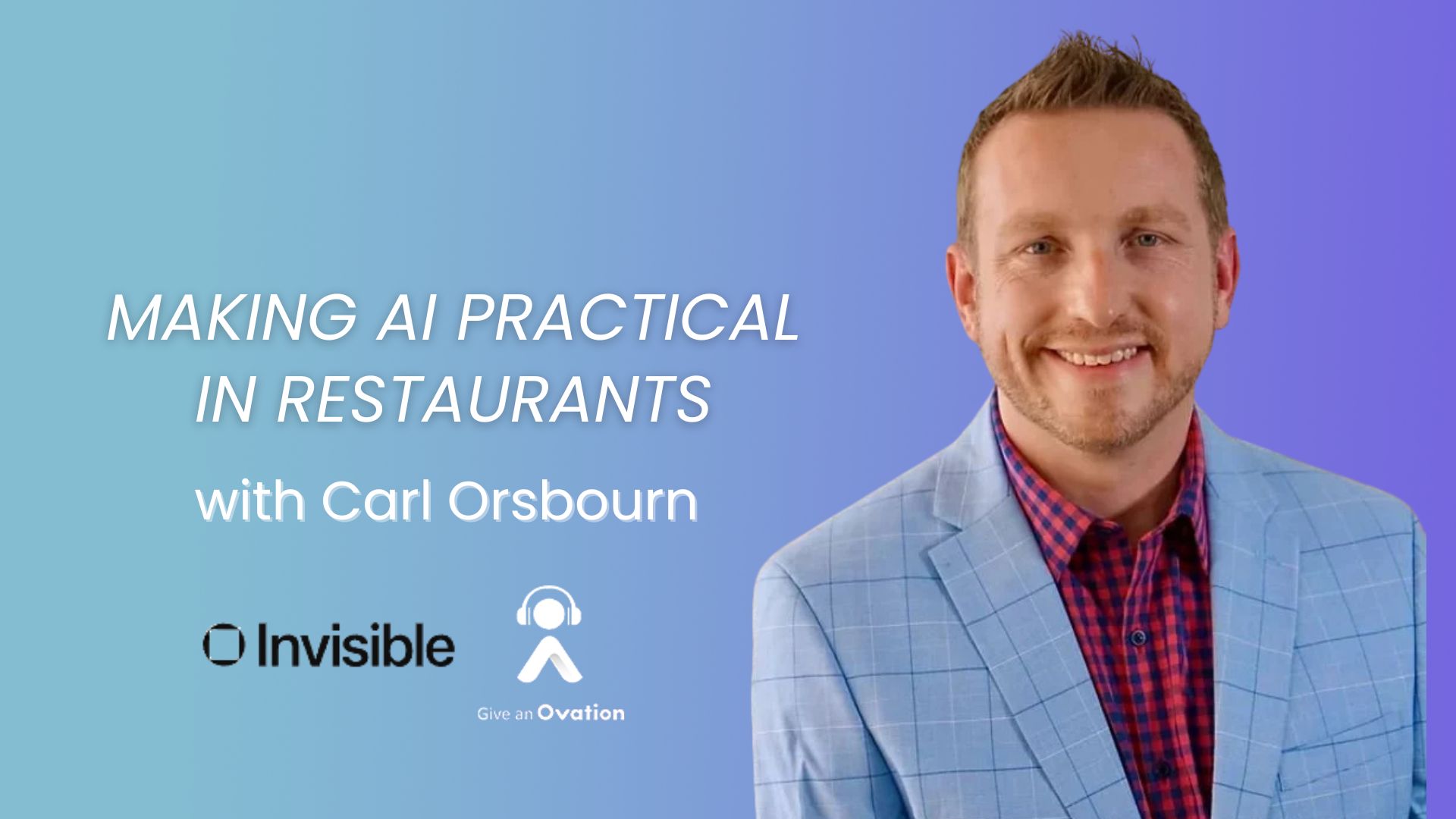
Carl shares why the most successful applications of AI focus on supporting teams, improving consistency, and removing friction rather than replacing people.
Why AI Needs to Be Practical (1:42)
“AI only works if it makes someone’s job easier.”
Carl explains that AI adoption fails when it is implemented for novelty instead of utility. The most effective tools solve real operational problems and help teams focus on what matters most in the guest experience.
AI Should Support People, Not Replace Them (4:10)
“The goal isn’t fewer people, it’s better outcomes.”
Carl emphasizes that AI should amplify human effort rather than eliminate it. When used correctly, technology allows teams to spend more time on hospitality and less time on repetitive tasks.
Removing Friction for Restaurant Teams (6:35)
“If you remove friction for employees, guests feel it immediately.”
Carl shares how reducing operational friction behind the scenes leads directly to better guest interactions. When teams are less stressed and more focused, service quality naturally improves.
Consistency Is Where AI Shines (9:02)
“AI helps you do the basics well every single day.”
Consistency is one of the hardest challenges in multi unit restaurants. Carl explains how AI can help standardize execution across locations without stripping away brand personality.
Avoiding the AI Hype Trap (11:28)
“Not every problem needs an AI solution.”
Carl cautions operators against chasing trends. Successful brands start with clear problems and adopt technology only when it meaningfully improves operations or guest experience.
Using AI to Elevate the Guest Experience (14:06)
“When teams are supported, guests feel taken care of.”
Carl ties everything back to the guest. When AI helps teams operate more smoothly, it creates space for better hospitality, stronger connections, and more memorable experiences.
Links:
https://www.linkedin.com/in/carlorsbourn/
https://www.linkedin.com/company/invisible-technologies-inc-/about/
Transcript
00:00:00:10 – 00:00:26:11
Zack Oates
Welcome to another edition of Give An Ovation, the Restaurant Guest Experience podcast. I’m your host, Zack Oates, and each week I chat with industry experts to get their strategies and tactics to help you create a five star guest experience. This podcast is powered by Ovation, the feedback and operations platform built for multi-day restaurants. Learn what’s actually happening in your restaurant and exactly what to improve while driving revenue.
00:00:26:17 – 00:00:52:06
Zack Oates
Learn more at ovation up.com. And today we have a first because we have a third. Carl Osborne joins us today. This is his third time on the podcast. And I am so excited because every time I chat with him it is just new stuff. He is so ingrained into what will be happening and what is happening in restaurants.
00:00:52:06 – 00:01:10:18
Zack Oates
And so Carl, welcome to the podcast. And you’re joining us right now, not only as a bestselling author for multiple books, a podcast host, a thought leader, but also as the SVP over at invisible. So welcome to the podcast again.
00:01:10:20 – 00:01:30:15
Carl Orsbourn
Thank you. Zach. I have to say, out of all the podcasts I join, your introduction is always the most dynamic and energized. If you’re not ready and excited to go, I mean, this is not the right podcast because I just love listening to your voice. Mind you, if you if ovation fails miserably, which it won’t, but if it does, if it does, your future and radio is secure, my friend.
00:01:30:19 – 00:01:51:02
Zack Oates
Because my goodness, if only though I had the boyish good looks of Carl and the accent because by the way, he did let me know. Because I always think that. Carl, for those of you who haven’t seen a picture of him, he looks like a good 5 to 7 years younger than me. And turns out he’s actually like nine years older than me.
00:01:51:07 – 00:01:58:23
Zack Oates
And so I asked him what the fountain of youth. And he informed me that it is just growing up without southern England, right?
00:01:59:00 – 00:02:07:18
Carl Orsbourn
That’s right. Maybe it’s also the lack of children in my life. Maybe that’s another factor, I guess. I hear you don’t get as much sleep as I do, so maybe it’s the beauty sleep that maybe comes back to us.
00:02:07:20 – 00:02:09:22
Zack Oates
Now familiar with this? This is like a kind of food.
00:02:09:22 – 00:02:16:03
Carl Orsbourn
Is this you’ve got you’ve got the whole family, and then you’re running a company. And so you’ve got two kind of whammies right there, my friend.
00:02:16:04 – 00:02:31:24
Zack Oates
Well, that’s why I do it the Utah way, which is 44oz of Diet Coke every or excuse me, Coke Zero every lunch. So that’s how we roll it. So, Carl, for those who don’t know, tell me a little bit about invisible. What is it and what attracted you to this company?
00:02:32:01 – 00:02:52:08
Carl Orsbourn
Yeah. Invisible is a ten year old coming. It’s a scale up more than a startup. It it’s something like 130 million in revenue. Last year, it’s been ranked as the second fastest growing AI company in the US. And it’s known primarily for training 80% of the world’s large language models. So you can think of the ChatGPT is the Geminis of this world.
00:02:52:14 – 00:03:16:20
Carl Orsbourn
Somehow these models were had to be built and trained over a number of years to be to the level that they are performing today. So our team were that right at the very beginning, the very first iteration of GVC invisible was supporting the the open AI folks. It’s a really interesting business because I, of course, is at the precipice of what is going to change all of our lives right now.
00:03:16:20 – 00:03:48:02
Carl Orsbourn
And so my role at the business is less on the kind of AI training model side that I just explained, but more about helping consumer facing businesses with bringing AI into the enterprise. And one of the things I often say to folks is that there’s so much hype, there’s so much hyperbole about this. And actually, when you look at the data and Gartner came out with some data recently that said something like 95%, 95% of all gen AI pilots that were launched in the last 12 months have failed to scale.
00:03:48:04 – 00:04:02:20
Zack Oates
Oh, interesting. That sounds like my dating life. How many first dates ended up in second? Not very many. And I was like, maybe we just give up on it. But it was about finding the right combination, not about just like doing it. Right.
00:04:02:22 – 00:04:21:17
Carl Orsbourn
That’s it. But also in the context of the AI story rather than the zaccheaus love story. Maybe it’s true on both counts, right? You got to start with the end in mind. And actually a lot of the businesses these days, we’ve got a lot of pressure, whether it be from the investor groups, the shareholders, the boards saying, look, we’ve got to be doing something with AI.
00:04:21:18 – 00:04:58:06
Carl Orsbourn
And so they bring something and they deploy something very quickly. And then what happens is the thing isn’t really measured particularly well. Maybe it’s been built on a shaky data foundation, and there is really someone champing at believing that this is going to be something that can differentiate the business. And so what we do is we’re a partner organization to the series of modules, and we basically structured data in its first instance with where we take structured and unstructured data, unify it into a platform that basically takes data through a medallion architecture from raw data where it doesn’t make much sense to actually clean it at all, to then a place where we actually can
00:04:58:06 – 00:05:24:13
Carl Orsbourn
derive insights. And then we take that into a module called atomic, which is a process builder. So you think of any digital workflow, whether it be invoice management, whether it be onboarding an emotion or procurement or some form of closure to your finance, financial books, any of those digital processes that exist. There are lots of steps. But here’s the thing that’s quite unique about us, in the sense that we are not a platform that works off the shelf.
00:05:24:13 – 00:05:52:21
Carl Orsbourn
We custom build everything around an organization’s current stack. So we’re not about replacing a CRM or an ERP or anything like that. We’re about working alongside it. So atomic is a process builder that outlines the steps necessary in an optimal fashion to work alongside the current tech stack. But then also we’ve got another module which is Radial Marketplace, which has something like 20,000 people around the world that are working to help us either train models or play a role.
00:05:52:22 – 00:06:10:08
Carl Orsbourn
A human in the loop is necessary alongside those digital workflows. And so that is kind of important because anyone that’s selling you anything which says AI does it all and you don’t have to worry about any humans. That’s also one of the fallacies. Humans are still very, very important as much as anything for risk mitigation, quality assurance and building.
00:06:10:08 – 00:06:17:08
Zack Oates
I love, by the way, what Tony Robbins says about that. He goes, I isn’t going to replace you. Someone that understands AI is going to replace you, right?
00:06:17:12 – 00:06:22:06
Carl Orsbourn
Yeah, well, Tony stole that from Harvard, and they know a thing about him, right? Yeah. All.
00:06:22:06 – 00:06:28:15
Zack Oates
The Tony DVDs that Tony Robbins didn’t doesn’t come up with all his own original material. Come on now, Carl.
00:06:28:17 – 00:06:50:21
Carl Orsbourn
He probably said it better than than him with that, with his booming voice. Right? I mean, he was probably far more compelling. Let’s, so you build out these, these workflows, but then you’ve got this piece that’s getting everyone’s attention right now, and that’s, our modules called axon, the genetic workflows. And this is like, you know, if I was pitching this business to you right now, Zach, I’d be bringing up this demo that we have, which we we should have an insurance claim.
00:06:50:21 – 00:07:05:14
Carl Orsbourn
It’s just so dynamic to watch it happen in front of you. But imagine you’re running, I don’t know, like, say, an insurance business. Right. And you’ve got a you’re doing all the claims and we know what it’s like. Everyone’s had a car accident. The length of time it takes to be able to get your money back after a car accident.
00:07:05:16 – 00:07:22:18
Carl Orsbourn
Well, what we’re doing with the genetic workflows is helping all of those workflows happen concurrent to each other. So in one corner, you’ll see the video of the car acts that are happening, the other you’ll see the 911 call being analyzed. We all, you’ll see the actual website being looked at for the regular use of, accidents happening on that particular intersection.
00:07:22:23 – 00:07:47:02
Carl Orsbourn
And all these things are working together as specific agents to then be able to tell a overarching story. Why then these agents, collaborate with each other and tell a human look, should we approve this claim or not? So you think about it from that angle. We get to a place where you then say, well, if we can start to apply AI in this world, then we move it away from the conversation that many people are having right now.
00:07:47:07 – 00:08:04:12
Carl Orsbourn
And it’s the thing that causes most fear and that is is AI going to take my job? And I think it’s a really interesting question because they’re of course going to probably be disruptions in the same way as before the dishwasher existed. There were people washing all the dishes, and then what happened was not like we lost people in our restaurants, right?
00:08:04:12 – 00:08:06:22
Carl Orsbourn
Like when AMD did other roles.
00:08:06:24 – 00:08:30:12
Zack Oates
Yeah, like I was actually just watching a show that was taking place in the early 1900s or the. Yeah, like the 1920s. And it showed like all these switchboard operators, like rooms full of these people that were switchboard operators and like they moved on and they found other jobs. There’s still more jobs to be done. And the fact that the phones created then more jobs of receptionists.
00:08:30:12 – 00:08:32:22
Zack Oates
Right. That wasn’t really a thing before.
00:08:32:24 – 00:09:00:24
Carl Orsbourn
Absolutely. Yeah. And if you approach I mean, in fact, I always say my biggest challenges in this business are either the inertia within the enterprise customers to see where this can potentially head or their willingness to take the gambling, moving this direction or the imagination to see what this really can do. Because if you think about this through the lens of what can I do with ten less people in my team, then you’re missing the opportunity of thinking, what would I do if I had a thousand more people?
00:09:00:24 – 00:09:20:09
Carl Orsbourn
It might say, oh, oh, right. And when you look at when we put this to a big dairy farm up in your part of the world and if you’d have thought about it as to how to run his farm with tell us people, we would have never got to where we got to because we said, if you can run your business with a thousand more people, where would you put those thousand people?
00:09:20:11 – 00:09:47:20
Carl Orsbourn
And he said, would I care about the welfare of my cows? And what I really want to be able to do is have more eyes on my cows. So we’ve developed a computer vision swarm drone kind of division, which is basically assessing these cows to see are they eating correctly? Are they displaying some early signs of infection. So that way he can then turn his human team on to care for those cows faster, and stopping them from being larger issues and ultimately improving the yield of this kind of farming activity.
00:09:47:20 – 00:10:02:00
Carl Orsbourn
Okay, that’s the kind of thing you can do with a thousand more people, right? So that’s part of the challenge in my role, Zach is helping people just open their eyes to different perspectives of how I really is going to transform and ultimately build differentiation into their offering.
00:10:02:02 – 00:10:30:13
Zack Oates
So I’m a brand, and I look at all these other huge things that were supposed to be NFTs. I look at the Segway, I look at these huge promises of, this is going to be the next frontier. And it didn’t quite match up. What is the difference? How do we prevent AI from being a pun intended segway into a flop versus a gateway into the future?
00:10:30:15 – 00:10:51:05
Carl Orsbourn
Yeah, that’s a good question, right? Because we’ve we’ve lived through a few in recent years and you mentioned a few there, but I think the evidence ultimately comes from seeing it in action and seen folks actually starting to deploy it. And we run across a number of different sectors, including the public sector and certainly industries that you could say are probably a little further advanced than the restaurant space.
00:10:51:07 – 00:11:19:14
Carl Orsbourn
But I think when you do that, you start to see some of the things that are being put in place right now and actually have been for for a little bit now, which are really driving forward adoption in that space. So I don’t think this is a question of if, but more a question of when. And the reason for that is that ultimately this is something that can allow us to do things at a velocity and at a pace and at a quality that we’ve never been able to do before.
00:11:19:16 – 00:11:42:08
Carl Orsbourn
But look, our space is a little different. You and I were doing another video thing recently where we were talking about how does this kind of thing affect the guest experience, and how does it really make customers feel about it. And I don’t know about you, but anytime I answer all of those phone calls and it’s one of those robotic voices telling me to press one or press two, it’s not as good as when I’m actually speaking to someone.
00:11:42:14 – 00:12:06:18
Carl Orsbourn
And I think ultimately where we need to think about AI in the hospitality sector at large is how do we create a better guest experience by allowing the humans that are involved in that to either be better prepared to art, to be able to create a better experience, or indeed to be able to ensure that they have the time and the utility to be able to do just that.
00:12:06:18 – 00:12:27:10
Carl Orsbourn
I you know, when I speak to operators, for example, in restaurant groups, I say I and I haven’t met one operator yet. That doesn’t say to me the best in my restaurants all the gems that spend the most amount of time with their team and or the best amount of time with their guests. And so then you ask, well, what about the other 90%?
00:12:27:12 – 00:12:43:20
Carl Orsbourn
And they say, well, they typically are using their time as effectively, or they’re being caught up with spending their time in the office doing tasks in front of the computer, or having to deal with lots of recruitment challenges or things like that. And that’s all I understand it, but let’s just operate in life. But then that’s the question mark.
00:12:43:20 – 00:12:56:00
Carl Orsbourn
I would then put to say, well, what can we do to get the GM out of the office? What can we do to. And yeah, I mean, even the customers more. Right. And that’s the kind of stuff that then we allow the humans to do what they do best. And that’s creating the best customer experiences.
00:12:56:02 – 00:13:21:04
Zack Oates
Because at the end of the day, it’s about connection, right? We could do everything else that we want, but it’s about connection. And like if there’s a brand that delivers every single time and it’s exactly the same, I could trust that brand. But if I have a negative experience with that brand, what am I going to do? First thing I do is I’m going to go try someone else and I’m going to see, is there anyone else who can do it better?
00:13:21:06 – 00:13:46:24
Zack Oates
And if there’s that connection, that is what creates true loyalty, more so than anything else that we can do. And the data proves it. In fact, a guest who has experienced real connection, which the best time to initiate that connection is actually right after a negative experience. If you have proper service recovery, that guest is 24 times more valuable than your average guest.
00:13:47:01 – 00:14:12:09
Zack Oates
They’re twice as likely to come back. They spend $5 more on each subsequent visit. Their frequency is two and a half times the average guest, and they’re 12 times more likely to leave you a five star review. So that connection is critical. But now it’s so it’s about what can I do to help enable that connection better. And the way that I’ve always looked at technology in hospitality is like the Tony Stark suit.
00:14:12:11 – 00:14:42:23
Zack Oates
It’s the Iron Man suit that makes Tony Stark a superhero. He’s just Tony Stark. He puts on the suit and he’s Iron Man, and that’s that simpatico right there of human and technology, I think, is what we need to do to help our people become the superheroes that they want to be. And then it’s about hiring the people who want to be out in the front, who don’t want to be at the computer, because those people technology can do the computer stuff for them.
00:14:43:03 – 00:15:03:19
Zack Oates
But looking someone in the whites of their eyes and saying, Carl, I’m glad you came in, or let me fix that for you, or answering a guest when they have a unique response that a unique complaint that that needs to be addressed by a human. Those are things that you need those individuals to do and that only they can do.
00:15:03:21 – 00:15:41:16
Zack Oates
And that’s how technology helps, not replaces. And I love that idea of flipping it around to how can I do this with less, with ten fewer people, as opposed to what would I do with a thousand more people? I mean, what a powerful question to ask. And I think something that each of us in our restaurant should be looking at and working with our vendors, working with our partners to not only share what you’re doing with AI, but also like ask them what’s on your roadmap and work with your vendors, because I’ll tell you, every single vendor that you are working with right now is investing heavily into AI.
00:15:41:16 – 00:16:05:00
Zack Oates
The question is, are you investing into having the infrastructure to adapt and adopt that AI? Because if not, what’s the good of having that vendor? You’re paying them not just for the service, but you’re paying them for the innovation. I’ve got a whole team of people that are building stuff that no one is paying for yet, and things that we’re not even going to be charging for just to make the product better.
00:16:05:02 – 00:16:20:14
Zack Oates
So, like I ask everyone, reach out to your vendors and make sure that you’re using it because I bet you 95% of restaurants are using half of what they are currently paying for that the vendors have built.
00:16:20:16 – 00:16:46:11
Carl Orsbourn
If not more. Yeah, if not more. I agree it’s and also, to what degree are those vendors actually listening to you to be able to adapt their product appropriately to fit your business? One of the big question marks right now that’s quite central, I think, to all of this, is we’ve been blessed in many ways as an industry, in many industries that are customer facing, to have had SAS these last ten, 15 years or so.
00:16:46:11 – 00:17:05:13
Carl Orsbourn
Right, which has enabled a lot of smaller businesses to be able to get access to capabilities that have allowed them to do things that before just impossible for a company of that size. But what’s happened also as a result of that is that we’ve created a situation whereby a lot of these SAS systems are not talking to each other.
00:17:05:15 – 00:17:29:02
Carl Orsbourn
And so therefore what we have in our arms now is a tech stack that isn’t really working in cahoots with each other. One of the big use cases around AI is demand forecasting. But you ask any restaurant executive how many demand forecasts actually exist in your business right now? And many of them will say, well, I’ve got one working with my labor faster.
00:17:29:04 – 00:17:47:01
Carl Orsbourn
I’ve got another thing have been to help me make sure I’ve got the right inventory in place. My business development team are thinking about this forecasting. The finance team are building the projections in this way. And so you suddenly said, well, hold on a second. Your operating your business of all these different forecasts. And it makes sense because they were operating off different systems at different iterations.
00:17:47:03 – 00:18:09:17
Carl Orsbourn
But the one thing that’s going to make a fail is that if the data isn’t right, and if you take bad data into a fight with good AI, the data will win every single time. And so one of the challenges that I think we’re going to run up against is how much are we going to find our ability as executives in this industry to really make sure our data can work across channels?
00:18:09:19 – 00:18:30:16
Carl Orsbourn
And this is more than just APIs, by the way. This is about having a holistic, interdependent system which allows a way for these data points to collaborate. So let me give you an example. I have this vision of us building this tool, which I’d love to call something like small GM, right. Something which allows us to really build on the hustle of great GM’s out there.
00:18:30:16 – 00:18:56:09
Carl Orsbourn
And today the great GM’s have the ability to see, to hear, to have the pulse of exactly what’s happening to their operation and make adjustments in that moment. But there are lots of things that they might not be aware of. So let’s give you an example. Let’s say you’re running a restaurant tonight. Zach and two of your cooks have just called out one of your refrigerators, and one of the predictive sensors in it is suggesting that the fridge might actually go down and fail within the next week.
00:18:56:11 – 00:19:07:20
Carl Orsbourn
And also, there’s a snowstorm coming through this evening. Now, there’s three different pieces of Intel, are things that the GM sometimes has to adjust to. But imagine if there was a smart GM AI.
00:19:07:20 – 00:19:15:07
Zack Oates
System that can just say, hey, get out of the restaurant industry. It’s too hard. Is that what is that what the system would do.
00:19:15:09 – 00:19:17:01
Carl Orsbourn
If we could just say that would be good, right? Yeah.
00:19:17:01 – 00:19:19:14
Zack Oates
92 imagine if.
00:19:19:14 – 00:19:37:17
Carl Orsbourn
It was able to say, don’t worry, I’ve hired the technician within the budget constraints that you’re after. They’re coming tomorrow during your off peak period. I actually think you need to move Susan across the beat tonight because typically you have higher delivery transactions when we get this kind of weather through, and you’ll probably have less people needing to be at the front because there’ll be less traffic coming in.
00:19:37:19 – 00:19:53:22
Carl Orsbourn
And also, I sent a message to the three people in your neighborhood store two miles away, who’ve got three part time workers that have made a request for extra hours. And actually, if you bring them over, that will cover up your shortfall. Imagine that GM having that type of capability. And are they going yes, yes, yes, that’s really helpful.
00:19:53:22 – 00:20:10:24
Carl Orsbourn
Or be able to be involved and engage with us. And actually I don’t want that person to ask somebody, well, this person because they’re an ex-girlfriend or whatever, but that type of interaction then, so it’s not just a prompt, but it’s actually an ability for the GM to be able to engage and to offer recommendations. That’s the world we’re heading towards.
00:20:11:01 – 00:20:17:06
Carl Orsbourn
But you can only do that when you start to tie these data threads together, where these things will start to play good with each other.
00:20:17:08 – 00:20:35:18
Zack Oates
Well, that is so powerful. And Carl, there’s so much that we could talk about here. We’ve just barely scratching the surface here. It’s a spoonful out of your ocean of wisdom and knowledge on AI. And so I appreciate you coming on and chat with us for a little bit. How can people find and follow you if there is, by chance, someone who doesn’t know you?
00:20:35:20 – 00:20:54:07
Carl Orsbourn
Well, I always link to this. My home is as many people that do know me know. So reach out to me on LinkedIn. Be mindful of that rather odd son, I move mine, it’s OSB and of course you can if you haven’t read the books yet and they’re both on Amazon, deliver in the digital restaurant to help you get some ideas as to what’s happening in the world of off premises and technology.
00:20:54:09 – 00:21:03:00
Zack Oates
Awesome. Well, Karl, for making the future where robots take over the world a little less scary. Today’s ovation goes to you. Thank you for joining us. I’m giving ovation.
00:21:03:02 – 00:21:04:18
Carl Orsbourn
Thank you Zach, nice to see.
00:21:04:20 – 00:21:27:07
Zack Oates
Thanks for joining us today. If you like this episode, leave us a review on Apple Podcasts or your favorite place to listen. We’re all about feedback here. Again, this episode was sponsored by ovation, a two question, SMS based, actionable guest feedback platform built for multi-unit restaurants. If you’d like to learn how we can help you measure and create a better guest experience, visit us at ovation up.com.
Thanks for reading! Make sure to check out the whole episode, as well as other interviews with restaurant gurus by checking out “Give an Ovation: A Podcast For Restaurants” on ovationup.com/podcast or your favorite place to listen to podcasts.