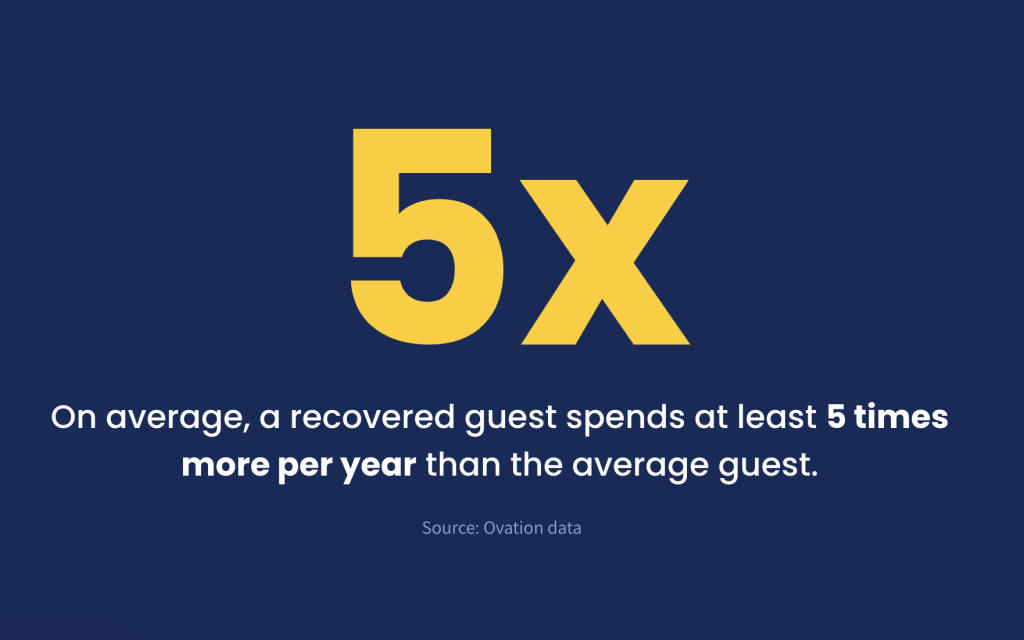
Guest recovery is a revenue channel for restaurants, not just a customer service function. According to Ovation data, recovered guests spend at least 5x more per year than the average guest.
So what does effective guest recovery look like in practice?
Ovation Enterprise Customer Success Manager Amanda Spradlin sat down with Jessica Drahem, Director of Learning & Development at Newk’s Eatery, for The ROI of Guest Recovery for Restaurants. Newk’s runs 96 locations and is one of the first brands using Ovation’s Guest Recovery Dashboard. Here’s what restaurant operators can take away from the conversation.
What is guest recovery for restaurants?
Guest recovery is the process of responding to negative guest feedback quickly and personally, making things right, and giving the guest a reason to return.
A bad experience doesn’t have to mean a lost guest. A fast, thoughtful response can turn a negative interaction into a chance to rebuild the relationship.
“Everybody makes a mistake. And most people are emotional about their food,” Jessica said. “The guest is not really mad about that. It’s how we respond to that.”
How much revenue can guest recovery generate?
A successful recovery isn’t about saving one transaction. It’s about protecting a guest relationship that keeps generating revenue.
At Newk’s, that impact shows up every month: roughly $61,000 in recovered revenue.
“As an operator myself, $61K a month, that’s what I look at. That’s where my eyes track immediately,” Jessica said.
The takeaway for operators: put a dollar value on guest recovery. When teams can see the revenue behind every save, recovery becomes a business metric, not just a customer service activity.
What metrics should restaurants track?
Four metrics give a clear picture of guest recovery performance:
- Recovery Revenue: the estimated revenue associated with recovered guests.
- Recovery Rate: the percentage of guests who received a response and returned.
- Response Rate: the percentage of negative feedback that receives a response.
- Average Response Time: how quickly the restaurant responds to negative feedback.
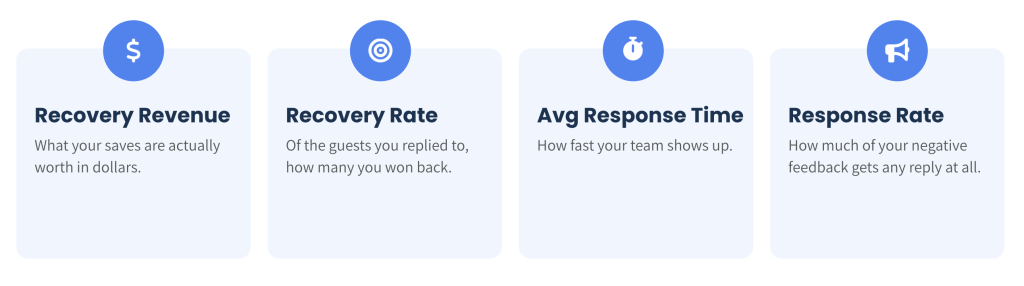
These metrics work together. A high recovery rate doesn’t tell the whole story if most unhappy guests never get a response.
Across Ovation customers, the average recovery rate is 47%. Newk’s is well above that benchmark at 62%, with a 93% response rate.
“As a trainer at heart, 62% recovery rate. I mean, come on,” Jessica said.
How does guest recovery data improve restaurant operations?
Guest recovery data shows operators which locations, team members, shifts, and issues are driving guest feedback.
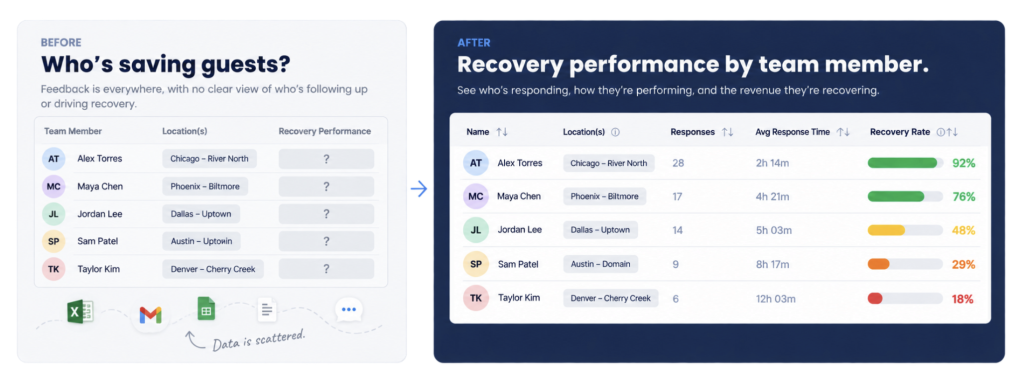
At Newk’s, that visibility has changed the conversation with operators.
“We used to talk about turning twos to threes and threes to fours. Our conversations have been more about fours to fives,” Jessica said. “Our operators are so competitive, we can talk about recovery rates by team members now rather than stores.”
The data also reveals operational patterns. “If there’s a pattern in the AM shift or the PM shift, you can use that as a tool with your staff,” she said. Use it to coach, not shame. The goal is closing gaps, not building a leaderboard of blame.
Speed matters, too.
“What Ovation has done for us is given us the information in real time, and so we’re able to respond in real time. That’s real value,” Jessica said. “If you don’t know about it, you can’t fix it.”
Why is guest recovery a revenue strategy?
Recovered guests come back, and they come back sooner.
At Newk’s, recovered guests returned about 23% faster and were roughly 6.7x more likely to return after a bad experience, based on the brand’s data from the first half of the year.
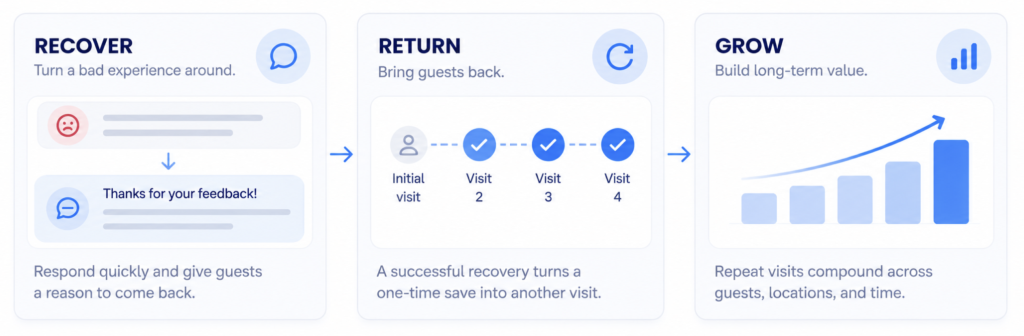
The path works in three stages:
- Recover: respond quickly and give the guest a reason to come back.
- Return: a successful recovery turns a one-time save into another visit.
- Grow: repeat visits compound across guests, locations, and time.
Follow up after the initial recovery, too. A second touch is what turns a save into a habit.
Does AI replace the human touch?
No. AI helps restaurant teams respond faster, while managers provide the personal connection.
Ovation’s Win Back tools suggest on-brand responses, and Newk’s managers personalize them before sending.
“I personally love the AI feature. But I also like to add my own personal touch to it. I’m not knocking it, I’m joining it,” Jessica said.
At Newk’s, managers reach out using their own names and take ownership of the guest relationship.
“I’m not some 1-800 number somewhere,” Jessica said. “I’m the manager of that location, and I’m going to make it right for them.”
The lesson for operators: use technology to make recovery faster, not less personal.
How should restaurants get started with guest recovery?
Jessica’s advice is to keep it human. “Make it personal, bold, make it authentic to your brand, and talk to your guests,” she said. “Text them, call them. Be authentic. That’s what people want.”
From there, we recommend five steps:
- Measure response rate. You can’t recover a guest you never respond to.
- Establish a recovery-rate baseline. Set a 90-day improvement goal.
- Give someone clear ownership. At Newk’s, each GM owns recovery for their location.
- Respond quickly and personally. Use technology to increase speed without losing the human touch.
- Look for patterns. Use guest feedback to spot recurring issues by location, shift, menu item, or team member.
Newk’s also uses short custom surveys to dig into specific menu items. Jessica ran one on mac and cheese. “That’s your own data, and you can share it with the group,” she said.
Guest recovery FAQs
What is a good guest recovery rate?
The average recovery rate across Ovation customers is 47%. Newk’s Eatery averages 62%.
What is the difference between recovery rate and response rate?
Response Rate measures the percentage of negative feedback that receives a response. Recovery Rate measures the percentage of guests who received a response and returned. A high recovery rate on a low response rate means most unhappy guests never heard from you.
What kind of recovery offer works best?
At Newk’s, entrée offers outperform drinks. “If an entree was offered, that guest is 6.5 times more likely to return. If a drink was offered, they are 2.5 times more likely to return,” Jessica said. The Guest Recovery Dashboard tracks offer effectiveness, so you can see which comps actually bring guests back.
How long does it take to see ROI from guest recovery?
Plan on 90 days to six months. “90 days to six months, to get a true picture of what’s going on,” Jessica said. Use that window to set goals, assess results, and adjust. To estimate your own opportunity, try the Guest Recovery ROI Calculator.
Does guest recovery work for single-location restaurants?
Yes. “When I was a GM, I only saw my store,” Jessica said. “You’re still getting the information, you’re still getting the connection with the guests.” The same principles apply whether you run one location or 100: listen, respond, make it right, and learn from the feedback.
The bottom line for restaurant operators
Guest recovery isn’t just about fixing a bad experience. It’s about protecting revenue, retaining guests, and seeing what’s happening across your restaurants.
The three biggest takeaways:
- Recovery is revenue. Recovery Revenue puts a dollar value on every save.
- Response rate is the lever. Every other number depends on reaching unhappy guests.
- Ownership drives results. Clear accountability turns guest feedback into action.
Watch the full webinar
Want to hear the full conversation with Jessica Drahem and see how Newk’s uses guest recovery data? Watch The ROI of Guest Recovery for Restaurants webinar on demand.
Want to estimate your own opportunity? Try the Guest Recovery ROI Calculator.